Tuesday, January 29, 2019

Thursday, January 24, 2019
Summarizing, Paraphrasing, and Quoting Notes and Practice
The slides below will walk you through the notes and practice activities over summarizing, quoting, and paraphrasing.
"A Vindication of the Rights of Women" Analysis
Our second Restoration piece is Mary Wollstonecraft's "A Vindication of the Rights of Women." During the 18th century, Wollstonecraft noticed that many women were not really able to lead their own lives or contribute to the household or any area of society due to society's expectations of women and the meager (small) education they received.
Wollstonecraft believed that educated women would benefit ALL of society - both men and women. And so, she decided to write this piece to try and convince the men in her society that women - who were viewed as weak, hysterical, and delicate - could and SHOULD get a real education and should become equal members of the household and in society.
She begins her piece by pointing out that the education women are currently receiving does nothing but cause women to "peak" early in life. They are beautiful and desired in their youth, but quickly become burdens who act childish and helpless. She blames the system of education set up by male authors who have written books that, while claiming to help women, still treat them as if they are "frivolous" or only concerned with matters that aren't serious. Ultimately, she claims this type of education - which only seeks to make women desirable - is better suited for mistresses and prostitutes, women who only desire the approval and love of men and not for women who deserve respect as wives and mothers.
She also points out how this system encourages women to maintain the status quo (the current social hierarchy) by pursuing love and approval from men rather than daring to try and improve themselves and become respectable. Their "education" prepares them for marriage and nothing else.

However, early on in the piece, she offers a concession to her argument, stating that men are more superior, on average, in terms of physical strength. But she then presents her counterargument that this strength has led to a dependence on men, not just in physical tasks, but in all things.
It shifts from "Let me help you open that jar, ma'am" to "You shouldn't be buying jars or having a job at all."
She then addresses a popular concern at the time: that education will make women "masculine." She takes issue with this claim because she points out that masculine actually has a dual meaning in her society.


Wollstonecraft believed that educated women would benefit ALL of society - both men and women. And so, she decided to write this piece to try and convince the men in her society that women - who were viewed as weak, hysterical, and delicate - could and SHOULD get a real education and should become equal members of the household and in society.
She begins her piece by pointing out that the education women are currently receiving does nothing but cause women to "peak" early in life. They are beautiful and desired in their youth, but quickly become burdens who act childish and helpless. She blames the system of education set up by male authors who have written books that, while claiming to help women, still treat them as if they are "frivolous" or only concerned with matters that aren't serious. Ultimately, she claims this type of education - which only seeks to make women desirable - is better suited for mistresses and prostitutes, women who only desire the approval and love of men and not for women who deserve respect as wives and mothers.
She also points out how this system encourages women to maintain the status quo (the current social hierarchy) by pursuing love and approval from men rather than daring to try and improve themselves and become respectable. Their "education" prepares them for marriage and nothing else.
However, early on in the piece, she offers a concession to her argument, stating that men are more superior, on average, in terms of physical strength. But she then presents her counterargument that this strength has led to a dependence on men, not just in physical tasks, but in all things.
It shifts from "Let me help you open that jar, ma'am" to "You shouldn't be buying jars or having a job at all."
She then addresses a popular concern at the time: that education will make women "masculine." She takes issue with this claim because she points out that masculine actually has a dual meaning in her society.
- To be burly, rough, macho, hands-on, and aggressive ("If by this appellation men mean to inveigh against their ardor in hunting, shooting, and gaming..." (line 47-48))
- To be independent, sophisticated, intelligent, and virtuous ("...if it be against the imitation of many virtues, or more properly speaking, the attainment of those talents and virtues, the exercise of which ennobles (improves) the human character..."(line 49-50))
She points out that it is rather unfair to criticize women for the first definition, but praise men for the second. She also addresses women directly for a moment, sarcastically asking them to forgive her directness, saying that women should not let the insult of being manly turn them away from self-improvement. Instead, they should view society's definition of femininity as weaknesses - letting your emotions control you, pretending to be delicate, having to speak quietly and softly, etc. She then warns that that type of behavior will work for a short time, but will ultimately turn a woman into something irritating or an "object of contempt" (line 62) because she will be unable to take care of a home or children.
She then turns to addressing men again, pointing out that society's expectation is to turn women into objects, not friends or lovers or even productive citizens. So she then asks men to forgive her and understand why she would so desire women to become more "manly."
Ultimately, though, she acknowledges that the fear of being "masculine" is just something told to young girls to keep them in line and a way to associate one gender with superiority.
In chapter 2, she addresses the situation of YOUNG men and women. When young men and women fall into puppy love, many of them rush into marriage. As time passes, the things that were once passionate begins to fade and women's "charms are oblique sunbeams" (line 96-97), bright but without substance. Her husband will eventually grow bored of it and, realizing his wife has no real personality, will start to wander.
Some women, upon being overlooked by their husbands, will become bitter and cheat. Other women will remain loyal, but will spend the rest of their days discontented, whining that they are neglected by their husbands.
Wollstonecraft insists that a married woman who is allowed to educate herself and keep herself healthy will find respect within herself and remain respectable even when married to a terrible husband. She will be able to look to herself for happiness rather than seeking it out in a husband who ignores her or no longer loves her.
She uses ethos in a few instances of the piece, mentioning the philosopher Rousseau and the writer Dr. John Gregory, pointing out the flaws in both of their works. She is especially displeased with Dr. Gregory's suggestion that women must suppress their passions and feelings in order to avoid men making assumptions about them. However, Wollstonecraft calls these men indecent (perverts and pedophiles in a modern sense) and urges that rational and sensible mothers not caution their daughters about things like that. After all, little girls shouldn't be held accountable for an adult's inappropriate attention. (Wollstonecraft uses terms like "common sense," and "truth" and "sensible," signalling that she is using logos in this passage)
Finally, she urges men to consider her suggestions, pointing out that it is unlikely women will ever try and surpass men, as they rely on them already for physical tasks. She also points out that an educated woman may earn her husband's respect and, thus, strengthening their bond of marriage through friendship and not dependence.
She explains that she believes a rational individual will always look to God first, then their own understanding, then to the understanding of men. She uses logos one final time when she states that if women cannot be given the freedom and liberty to improve themselves, they are merely slaves to society and will become like withering beautiful flowers.
Wednesday, January 16, 2019
"A Modest Proposal" Analysis
After finishing our reading of "A Modest Proposal," we took a step back and analyzed how Swift makes his satire effective.
Firstly, he is a skilled user of verbal irony. This is where the author says one thing, but actually means something VERY different. For instance, consider the table below (this table is on the front of your Restoration packet btw!):
So, Swift's piece makes good use of irony to transform it into a very perceptive piece of satire. However, as Swift's satirical proposal is so horrific, he must do a great deal of work to create what sounds like a reasonable persuasive argument. He does this through the use of the rhetorical appeals - ethos, pathos, and logos. In your Restoration packet, you will find a tri-chart with these three appeals as the header. Here are some of the instances of these three rhetorical appeals that we found:
Swift's use of rhetorical appeals is important. If he had simply started his essay by proposing to eat poor children, most readers would immediately disconnect and pass the piece off as nothing but an obscene joke. Instead, he draws the reader in by showing them the real size of the problem, making the reader care about the problem, and demonstrating himself to be a reliable and well-informed individual. THEN he suggests eating babies.
Swift offers a great many supports in the form of benefits his plan will bring to the country. Here are a few of them:
Firstly, he is a skilled user of verbal irony. This is where the author says one thing, but actually means something VERY different. For instance, consider the table below (this table is on the front of your Restoration packet btw!):
| What Swift States | What Swift Means |
| The title of the selection, “A Modest Proposal” | Swift’s proposal is hardly modest; it is outrageous and likely to cause horror in readers |
| “…although I rather recommend buying the children alive and dressing them hot from the knife…” | The rich view the Irish as animals, not as human |
| “I have not the least personal interest in endeavoring to promote this necessary work…” | Swift is actually outraged by the treatment of the Irish by the English and has a large personal interest in the issue |
| “…as they have already devoured most of the parents…” | Landlords have consumed all of the resources and have drained the Irish of all money, work, and livelihood |
| Logos (Logic) | Pathos (Emotion) | Ethos (Credibility) |
| Line 90-97: Swift’s plan will bring profit to poor families for each child sold | Line 1-8: Describing the streets filled with women and children begging for food and money | Line 83-84: He was given information from a notable French doctor |
| Line 159-162: The plan will bring up to $50,000 per year in profit to the nation | Line 30 – 34: Describing the abortions and murder of children by mothers who cannot afford to care for them | Line 105-107: Swift states he took feedback and input from people that could be considered respectable |
| Line 35-43: He calculates the exact number of impoverished parents and children in the country to show the extent of the problem | Line 98-100: Swift crosses the line from formal to crass when describing using a baby’s skin being used to make gloves or boots. | Line 249-252: Swift states since the plan will not affect him, he is unbiased in suggesting this plan. |
Swift's use of rhetorical appeals is important. If he had simply started his essay by proposing to eat poor children, most readers would immediately disconnect and pass the piece off as nothing but an obscene joke. Instead, he draws the reader in by showing them the real size of the problem, making the reader care about the problem, and demonstrating himself to be a reliable and well-informed individual. THEN he suggests eating babies.
Swift offers a great many supports in the form of benefits his plan will bring to the country. Here are a few of them:
- The poor children will help feed and clothe thousands
- The relationship between tenants and landlords will improve along with the relationships between husbands and wives.
- Women will become better mothers and be able to work more after selling off their child.
- It will help to stimulate trade and the economy.
- The wealthy will want to visit Ireland more due to the new exotic dish.
- The population of Catholics and Irish will be reduced.
- It will provide a source of food and income for the poor.
Despite the large number of benefits, Swift still includes a concession to make the satire meaningful. Towards the end of the piece, he concedes that there actually exists a long list of alternative solutions such as taxing absentee landlords, inspiring national pride, reducing the consumption of foreign goods, and actually having compassion, but he rejects all of these ideas outright because he states that no one actually wants to do these things. His concession is important because he doesn't just acknowledge the alternatives and then brush them off. He uses it as a way to make his true purpose known amidst all the satirical suggestions. Then concession reveals his true purpose to the audience and drives the point home.
Monday, January 14, 2019
"A Modest Proposal" Background and Intro
We begin our Restoration unit with the essay called "A Modest Proposal" by Jonathan Swift. Today in class, we got about halfway through Swift's piece and answered the numbered questions in the restoration packet below.
Before we get into the essay, let me summarize up the background of this piece.
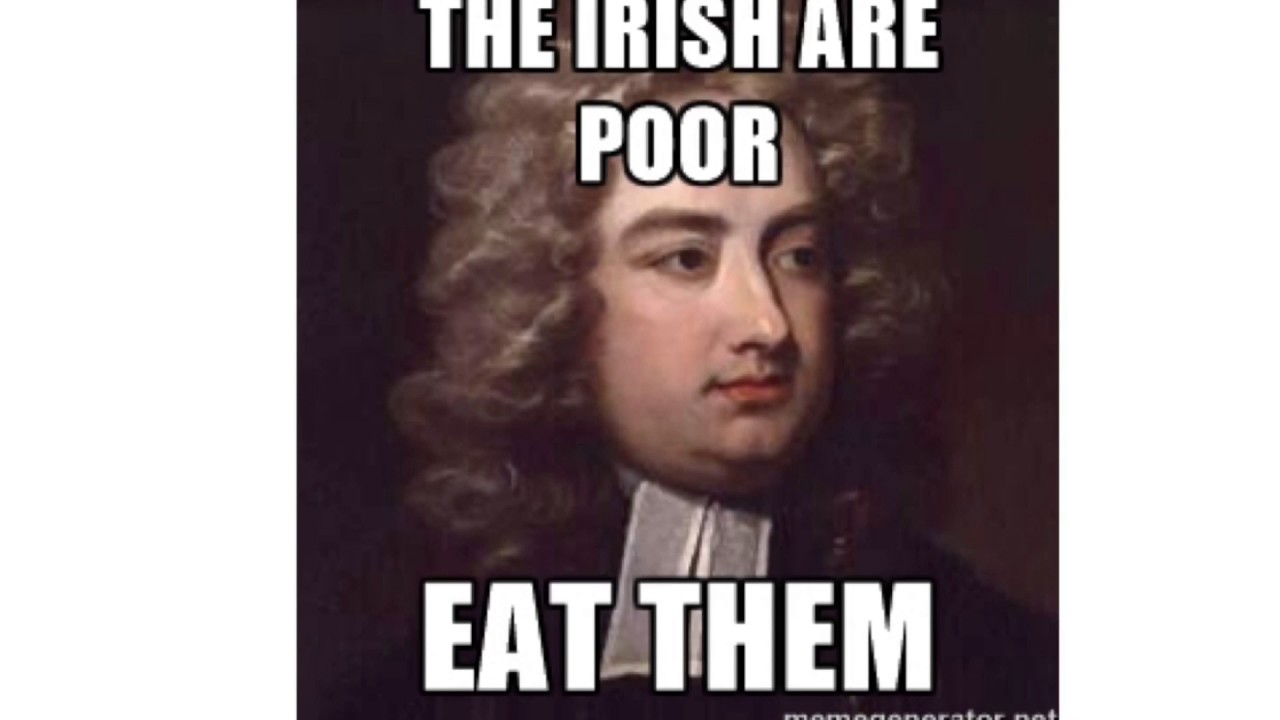

Before we get into the essay, let me summarize up the background of this piece.
- Swift was born in Dublin, Ireland, but was raised by an English family who was very well-off. He was well educated.
- The Irish had been under English control for almost 500 years. For awhile, things were alright, but the English became progressively more controlling and cruel to the Irish people.
- The English were Protestant and hated the Irish Catholics. They considered the Irish people to be lazy, savage, and uncivilized.
- The English owned homes and plantations in Ireland and taxed the Irish people who lived on the lands. When the crops failed to yield food in the 1720's, the English went back to England but continued to tax the Irish people.
- Swift is using satire like Chaucer did. He is coming up with an OUTRAGEOUS suggestion to call out the English people for their cruelty and unfairness towards the Irish people.
We begin the piece with Swift pointing out that Ireland is filled with women and children begging in the streets. He points out that the women are forced into begging in order to care for all of their kids. This only leads to children who give nothing back to society and simply become thieves or are sold off into slavery or servitude.
Swift then states he has a plan to turn these children who, after their first year of life, become a drain on their parents and society and instead turn them into a resource to help the community.
He calculates the total number of children born to poor parents each year. He uses the word breeders to describe the women. This is a degrading and dehumanizing term used mainly for animals and livestock. Swift is writing his piece from the stereotypical Englishman's view. The English treated the Irish almost like animals, so Swift points it out by referring to the Irish in dehumanizing terms to call out his fellow man for being so cruel.
He then makes what he calls a logical and simple proposal:
Because these children cannot be cared for properly and they give nothing to society, it would make logical sense to allow parents of these babies to sell them for meat.
Yes, he proposes that the solution is to turn children into food and not to address the outrageous taxes enforced by the English.
He goes on to explain that it actually isn't that outlandish by pointing out that the rich English land owners have taken everything else from the Irish people ("...as they have already devoured most of the parents...") and so taking their children wouldn't be that big of a leap.
He then begins to enumerate the benefits of such as system: the poor would have a good source of income, the rich would have an exotic new food, the butcher would always have a job, and landlords would make sure to take good care of child-bearing tenants and families in order to produce the best meat.
While he does make concessions regarding his plan, he refutes most of them by pointing out the logical rather than the ethical or emotional impacts of his plan. He keeps his tone very formal and serious, but not somber in order to avoid even discussing the emotional aspects. Again, he is doing this to reflect what he sees as England's cruel and heartless attitude towards the suffering of the Irish.
In our next few classes, we will see how Swift uses rhetorical appeals, and counter arguments. Below, you will find a PDF of the piece along with the text we will be reading next week as well as the packet with the questions and activities we will be doing in class.
Friday, January 11, 2019
Wednesday, January 9, 2019
Argument Topic Activity/Brainstorm
In this activity, you will work with your group to explore the possible claims and issues involved in the provided prompts for our argument essay. This activity is meant to help you develop some background knowledge for each prompt and decide which prompt you would most like to write about. Below are the four articles over each of the four prompts.
Here is the handout we will work on in class. This is a graded assignment and should be turned in. If you are absent on January 10th, be sure to turn it in upon your return or attend tutoring for assistance in completing it.
Here is the handout we will work on in class. This is a graded assignment and should be turned in. If you are absent on January 10th, be sure to turn it in upon your return or attend tutoring for assistance in completing it.
Tuesday, January 8, 2019
Argument Basics Notes
This quarter, we will be focusing on the essential question how can persuasion and rhetoric be used to manipulate our sense of morality and perception of reality? We will be examining how we can use rhetoric in an argument essay to prove and convince a reader we are correct and also reading texts in which individuals use lies, deceit, and persuasion to play on people's sense of right and wrong.
To begin our unit, we discussed the process of developing the general outline of an argument essay. You can find the fill-in-the-blank notes and the slides to go with them below.
To begin our unit, we discussed the process of developing the general outline of an argument essay. You can find the fill-in-the-blank notes and the slides to go with them below.
Subscribe to:
Posts (Atom)
Socratic Seminar Preparation
If you lost your Socratic Seminar materials... If you are confused by something on your handouts... If you just need some reassurance and cl...

-
Today, during Writing Friday, we worked on editing and revising. I passed back essays to individuals who had submitted one by the deadline s...
-
During our Writing Friday today, we discussed the introduction to the college essay. After our vocab practice during our warm-up, we discuss...
-
Your homework assignment for this unit is to read a tale that is NOT located in our text book and to respond to that story. For this assignm...

