Showing posts with label writing friday. Show all posts
Showing posts with label writing friday. Show all posts
Thursday, October 25, 2018

Friday, September 14, 2018
Writing Friday: College Essay - Peer and Self Editing
Today, during Writing Friday, we worked on editing and revising. I passed back essays to individuals who had submitted one by the deadline so they could review my comments and feedback. If you are unsure of what a mark means on your paper, here is a key for my feedback system.
Then, we discussed some facets of MLA formatting, such as the appropriate header, the correct margin size, and how to format paragraphs. You can see a video tutorial below of how to make sure your essay is MLA formatted in Microsoft Word.
To start, we talked about some general advice that everyone can follow:
Then, we discussed some facets of MLA formatting, such as the appropriate header, the correct margin size, and how to format paragraphs. You can see a video tutorial below of how to make sure your essay is MLA formatted in Microsoft Word.
To start, we talked about some general advice that everyone can follow:
- Avoid using basic words like good, bad, sad, kid, things, nice, etc.
- Would HAVE, could HAVE, should HAVE. Not "would of."
- My family
anand I... - Make sure you are using the correct homonym. If you aren't sure what each one means, watch this video to start.
- Avoid any of the following phrases which are just redundant, too casual, and not at all necessary
- "What I'm trying to say is..."
- "My point being..."
- "I mean..."
- Finally, SHOW, don't tell. You can tell me all you want that you're confident, but you need to show me the moment you demonstrated that confidence. I can say I'm an astronaut, but it's not true until I actually go to the moon.
Finally, we began our peer editing. The editor completes step one of the handout below. Then, they give the handout and essay back to the person they were editing for. If you weren't in class or if you didn't get feedback on everything, this could also be a friend, a parent, or another teacher. Make sure it's someone you trust and wants the best for you. You are supposed to do anything marked "For the author" and step two on your own. I will be checking that portion for a grade. You will turn in this completed handout along with your final draft.
Your assignment this weekend is to revise and type up your final essay. It should be in MLA format and be a sample of your best effort. If you aren't sure what I'm looking for, go through the self-editing checklist and rubric below while you work.
Friday, September 7, 2018
Writing Friday: College Essay - Body, Conclusion, and Model Essays
On this Writing Friday, we worked on completing our rough draft of our college essays. Now, remember that your college essay should reflect:
- Your strengths
- Your goals
- Your personal style
Since these things are different for everyone, everybody's essay may look a bit different. I can give you some guidance and advice, and so can tons of universities like this one and this one and this one. However, there is no set structure or style that your essay must be written in.
Your essay should reflect you in all ways.
In order to start writing our body and conclusion, I wanted to make sure we all had a chance to see what a successful college essay might look like, so I set out to find some good ones.
Well, I found some great ones.
Back in 2001, NPR's "Morning Edition" asked students to send in their successful college essays. The packet below contains 4 essays they thought were the best of them. Notice how they are all somewhat different in style, structure, and tone.
Amber Espinoza's essay is emotional, heartfelt, and a testament to the struggles she has overcome in her life. Her essay has a more formal style - she gives details and examples and explains how they have changed her or her perspective - but also uses things like dialogue and some conversational parts to make it sound more natural.
Leo Stoscheck is much more creative and poetic in his form. His paragraphs are lengthy, his vocabulary is sensory and detailed, his sentences are varied and demonstrate his talent at creating a flow in his writing. He focuses on location and the significance of it. He demonstrates how observant and appreciative he is of the world around him and crafts extended metaphors.
Clayton Kennedy blends creativity and introspection. He reflects back on a time in his life when he seemed at his lowest. He directly confronts something most would find difficult to even look at in ourselves. He makes allusions to authors and artists to demonstrate his point.
Finally, Leah Knobler compares herself to her brother, not because she feels lesser than him. She tells it in pure story format of the realization that she could be the things her brother is not. She refuses to live in his shadow and in the same breath thanks him for the shade he casts over her. Her vocabulary is not as sophisticated as Leo or Clayton, but it still gets the job done.
As you can see, the RIGHT style for your essay is the one that feels NATURAL to you.
As for what you should write about, consider what our classes identified in Leah's essay together:
Ultimately, you could read through hundreds of example essays and advice columns. They won't tell you the magic formula to write your college essay. But if you really want some help, here are a few small pieces of advice to follow:
- Paint us a picture when necessary. Show, don't tell. Give details, dialogue, etc. Make scenes come alive if it feels like your writing is just kind of dragging along.
- Demonstrate that you are a complex individual, not just a stereotype. The admissions board will have probably already seen your GPA, your transcript, your recommendations, and your extracurriculars. They may already think they know who you are. Maybe you have a dream or a passion you've never told anyone about. Let them know that!
- Show maturity, adaptability, and introspection. Show them that you don't just let your problems stand in your way; explain how you actively work to solve problems. Ghandi once said "Be the change you wish to see in the world." Show the admissions board that you don't just wait for the problem come to you...you go to the problem and change it yourself.
- Maintain the likability factor. Confidence is good. Arrogance is not. Show that you will always give YOUR 100%.
I know it can be scary because ultimately, you are putting something on paper that you think is beautiful and special about you (and yes, there is something beautiful and special in ALL OF YOU) and it can be terrifying to think that someone else might not find that part of you beautiful and special too. This is a risk worth taking though, because those who read it will be able to tell it's a risk. And they (and me) will appreciate you so much for it.
Your assignment this weekend is to work on the rest of your essay. Just like before, feel free to email me what you write. If you have shared it with me on Google Drive, just send me an email notifying me that you have updated the document and want feedback. I will work as quickly as I can to give that meaningful feedback to you.
Now, have a great weekend!
Friday, August 31, 2018
Writing Friday: College Essay - Introductions
During our Writing Friday today, we discussed the introduction to the college essay. After our vocab practice during our warm-up, we discussed ALL of the things we remember about writing introductions to essays from all of our English classes.
Why?
Because there is no outline for this essay!
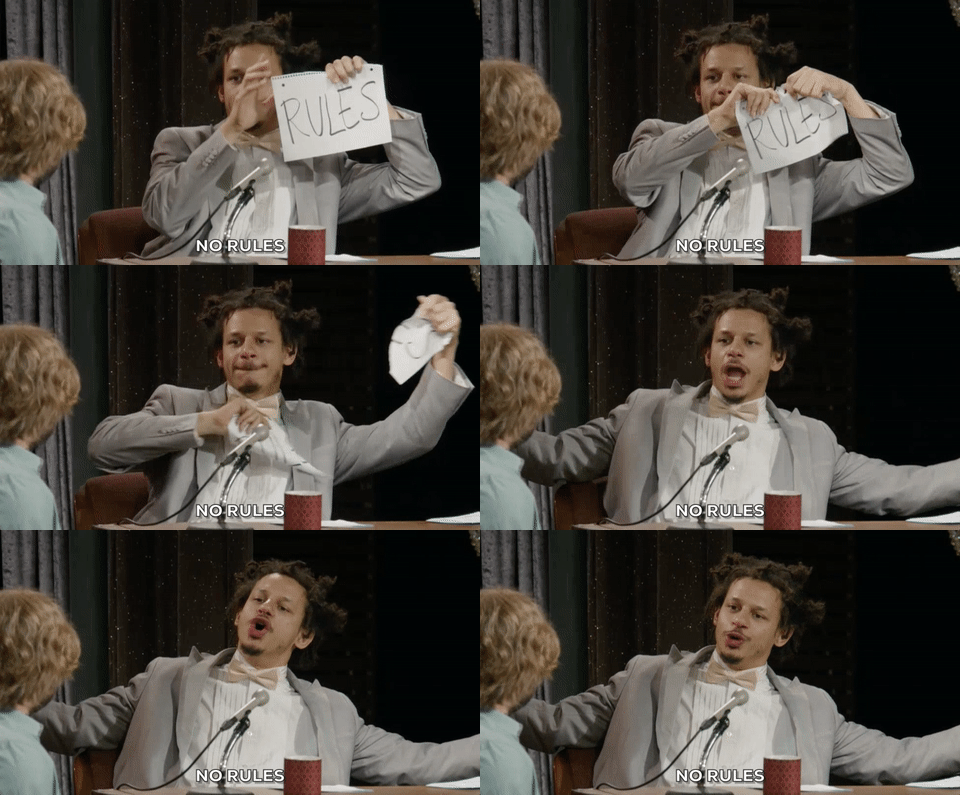
That's right, this is a chance for you to break the mold. You don't have to follow an outline, a formula, or a set of arbitrary rules. You only have to make sure your writing is between 1 1/2 - 2 pages and make sure it demonstrates the best of you and your writing skills.
But, all that freedom can be kind of scary.
Now, before you say, "But, Miss Hamman, I don't know what to write!", please understand that you have had 11 solid years of English education. Your past teachers have been packing your tool box with all of the tools you need to craft a paper that shows off the best things about you.
YOU just have to decide what it is you want to build and how.
It may feel, at first, like you are aimlessly wandering with your essay. You may feel like you want to erase everything and start over. DON'T. Just write. You don't have to keep every sentence. You don't have to keep every word. But keep them on the page until you feel you've made your point. Then go back and get rid of the stuff you don't need.
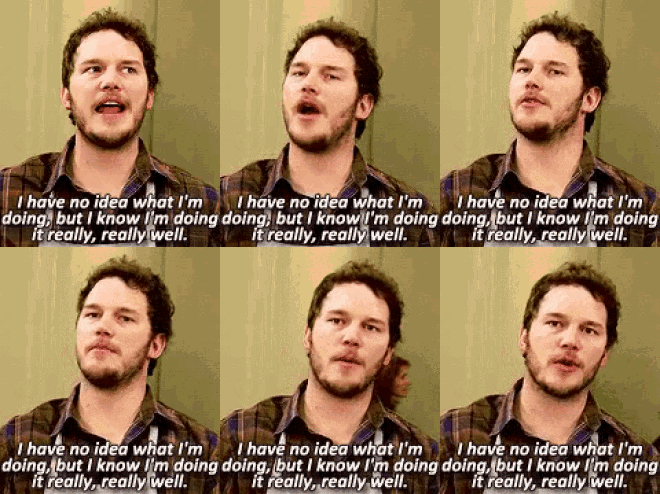
Your essay, like all essays, will have a thesis. That thesis should state why you deserve to be accepted to the university of your choice. This could be a trait you possess, a talent you have, or a perspective you could bring to the campus.
In the powerpoint below, you'll see suggestions of things to use to write your introduction from all of my classes. Look through them if you need ideas.
After we discussed the tools we all have, we then talked about how to start using them. I decided to pick prompt #2 for MY essay: "Most students have an identity, an interest, or talent that defines them in an essential way. Tell us about yourself."
So, I started to think about what I felt most shaped me as a person - who/what I identify with, what I'm passionate about, or what I'm good at. Ultimately, I narrowed it down to my identity. More specifically, I focused on how a particular EVENT involving my identity shaped me.
Below are the notes I took on part of my graphic organizer that we reviewed together as a class.
From these notes, we deduced that my identity shaped me by making me more adaptive. I identify myself as a teacher with supportive friends from the Midwest. When I moved to Texas, that shaped me as a person by forcing me to adapt to new surroundings and my career.
We decided to start with an attention grabber/hook of some sort. In some classes, we began with a quote. In others, we began with a question. One class wanted to start with dialogue. Ultimately, how you make your reader care is up to you.

From there, we decided to elaborate a little on our hook. What was it referring to or why was it significant to the essay. It usually involved me reflecting on or explaining how I had gotten to where I was in the moment I described in my hook.
Finally, we tied it all together in my thesis. Now, I don't just want to come out and say "I think I should be accepted to ___________ University because I know how to adapt." First off, that's kind of boring and a little too direct. Secondly, it doesn't really show that I know how to adapt, BECAUSE IT'S JUST A COOKIE CUTTER THESIS. Is it okay to write a thesis like this in your rough draft? MOST DEFINITELY. However, eventually, you will probably want to change it in your final draft.
Take a look at some of the examples our classes came up with below.
Your assignment this weekend is to write YOUR introduction. You may type or handwrite.
BONUS: send it to me this weekend. You can send it via email, you can snap a picture of it, you can read it aloud and send me the audio. However you choose. (This is not a grade, nor is it extra credit, but it helps YOU and ME by giving me an idea of where you are heading with your essay and allowing me processing time to give feedback)

Have a GREAT weekend and GO EAGLES!
Why?
Because there is no outline for this essay!
That's right, this is a chance for you to break the mold. You don't have to follow an outline, a formula, or a set of arbitrary rules. You only have to make sure your writing is between 1 1/2 - 2 pages and make sure it demonstrates the best of you and your writing skills.
But, all that freedom can be kind of scary.
Now, before you say, "But, Miss Hamman, I don't know what to write!", please understand that you have had 11 solid years of English education. Your past teachers have been packing your tool box with all of the tools you need to craft a paper that shows off the best things about you.
YOU just have to decide what it is you want to build and how.
It may feel, at first, like you are aimlessly wandering with your essay. You may feel like you want to erase everything and start over. DON'T. Just write. You don't have to keep every sentence. You don't have to keep every word. But keep them on the page until you feel you've made your point. Then go back and get rid of the stuff you don't need.
Your essay, like all essays, will have a thesis. That thesis should state why you deserve to be accepted to the university of your choice. This could be a trait you possess, a talent you have, or a perspective you could bring to the campus.
In the powerpoint below, you'll see suggestions of things to use to write your introduction from all of my classes. Look through them if you need ideas.
After we discussed the tools we all have, we then talked about how to start using them. I decided to pick prompt #2 for MY essay: "Most students have an identity, an interest, or talent that defines them in an essential way. Tell us about yourself."
So, I started to think about what I felt most shaped me as a person - who/what I identify with, what I'm passionate about, or what I'm good at. Ultimately, I narrowed it down to my identity. More specifically, I focused on how a particular EVENT involving my identity shaped me.
Below are the notes I took on part of my graphic organizer that we reviewed together as a class.
From these notes, we deduced that my identity shaped me by making me more adaptive. I identify myself as a teacher with supportive friends from the Midwest. When I moved to Texas, that shaped me as a person by forcing me to adapt to new surroundings and my career.
We decided to start with an attention grabber/hook of some sort. In some classes, we began with a quote. In others, we began with a question. One class wanted to start with dialogue. Ultimately, how you make your reader care is up to you.
From there, we decided to elaborate a little on our hook. What was it referring to or why was it significant to the essay. It usually involved me reflecting on or explaining how I had gotten to where I was in the moment I described in my hook.
Finally, we tied it all together in my thesis. Now, I don't just want to come out and say "I think I should be accepted to ___________ University because I know how to adapt." First off, that's kind of boring and a little too direct. Secondly, it doesn't really show that I know how to adapt, BECAUSE IT'S JUST A COOKIE CUTTER THESIS. Is it okay to write a thesis like this in your rough draft? MOST DEFINITELY. However, eventually, you will probably want to change it in your final draft.
Take a look at some of the examples our classes came up with below.
Your assignment this weekend is to write YOUR introduction. You may type or handwrite.
BONUS: send it to me this weekend. You can send it via email, you can snap a picture of it, you can read it aloud and send me the audio. However you choose. (This is not a grade, nor is it extra credit, but it helps YOU and ME by giving me an idea of where you are heading with your essay and allowing me processing time to give feedback)
Have a GREAT weekend and GO EAGLES!
Subscribe to:
Posts (Atom)
Socratic Seminar Preparation
If you lost your Socratic Seminar materials... If you are confused by something on your handouts... If you just need some reassurance and cl...

-
Today, during Writing Friday, we worked on editing and revising. I passed back essays to individuals who had submitted one by the deadline s...
-
During our Writing Friday today, we discussed the introduction to the college essay. After our vocab practice during our warm-up, we discuss...
-
Your homework assignment for this unit is to read a tale that is NOT located in our text book and to respond to that story. For this assignm...

