Before we get into the essay, let me summarize up the background of this piece.
- Swift was born in Dublin, Ireland, but was raised by an English family who was very well-off. He was well educated.
- The Irish had been under English control for almost 500 years. For awhile, things were alright, but the English became progressively more controlling and cruel to the Irish people.
- The English were Protestant and hated the Irish Catholics. They considered the Irish people to be lazy, savage, and uncivilized.
- The English owned homes and plantations in Ireland and taxed the Irish people who lived on the lands. When the crops failed to yield food in the 1720's, the English went back to England but continued to tax the Irish people.
- Swift is using satire like Chaucer did. He is coming up with an OUTRAGEOUS suggestion to call out the English people for their cruelty and unfairness towards the Irish people.
We begin the piece with Swift pointing out that Ireland is filled with women and children begging in the streets. He points out that the women are forced into begging in order to care for all of their kids. This only leads to children who give nothing back to society and simply become thieves or are sold off into slavery or servitude.
Swift then states he has a plan to turn these children who, after their first year of life, become a drain on their parents and society and instead turn them into a resource to help the community.
He calculates the total number of children born to poor parents each year. He uses the word breeders to describe the women. This is a degrading and dehumanizing term used mainly for animals and livestock. Swift is writing his piece from the stereotypical Englishman's view. The English treated the Irish almost like animals, so Swift points it out by referring to the Irish in dehumanizing terms to call out his fellow man for being so cruel.
He then makes what he calls a logical and simple proposal:
Because these children cannot be cared for properly and they give nothing to society, it would make logical sense to allow parents of these babies to sell them for meat.
Yes, he proposes that the solution is to turn children into food and not to address the outrageous taxes enforced by the English.
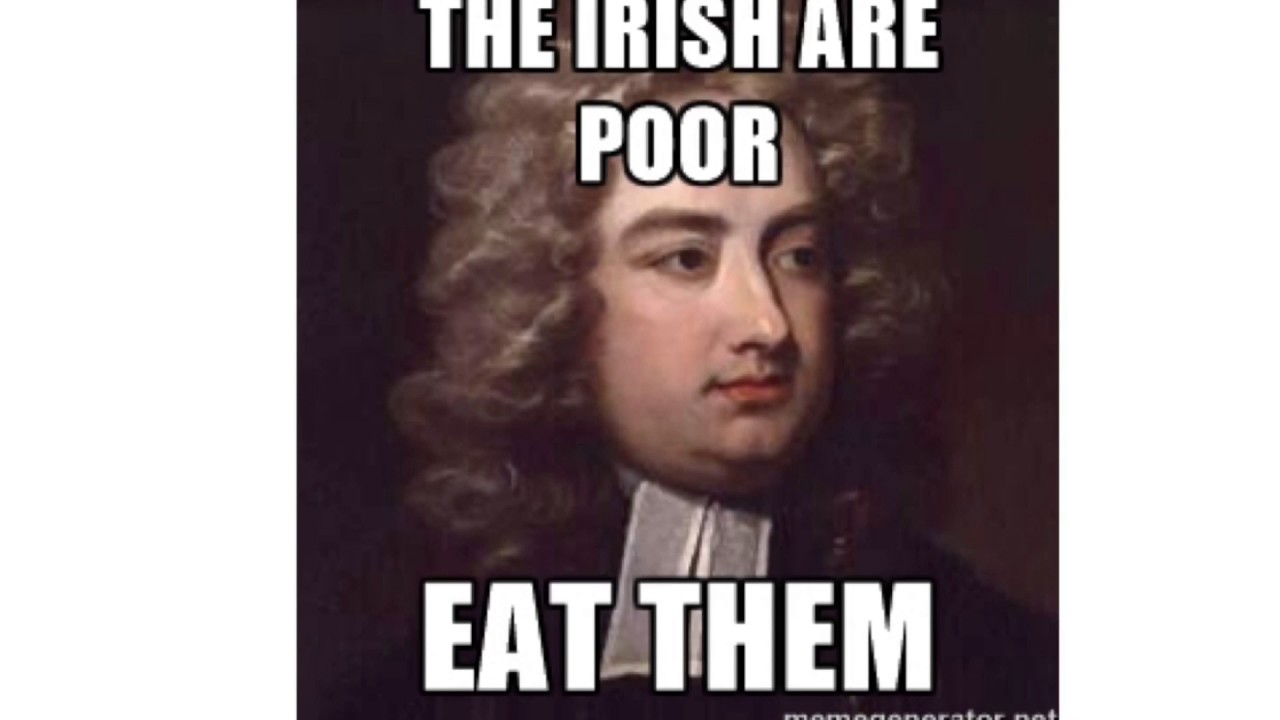
He goes on to explain that it actually isn't that outlandish by pointing out that the rich English land owners have taken everything else from the Irish people ("...as they have already devoured most of the parents...") and so taking their children wouldn't be that big of a leap.
He then begins to enumerate the benefits of such as system: the poor would have a good source of income, the rich would have an exotic new food, the butcher would always have a job, and landlords would make sure to take good care of child-bearing tenants and families in order to produce the best meat.
While he does make concessions regarding his plan, he refutes most of them by pointing out the logical rather than the ethical or emotional impacts of his plan. He keeps his tone very formal and serious, but not somber in order to avoid even discussing the emotional aspects. Again, he is doing this to reflect what he sees as England's cruel and heartless attitude towards the suffering of the Irish.
In our next few classes, we will see how Swift uses rhetorical appeals, and counter arguments. Below, you will find a PDF of the piece along with the text we will be reading next week as well as the packet with the questions and activities we will be doing in class.


No comments:
Post a Comment